Introduction
What exactly is MSG? It's a common ingredient in cooking around the world, particularly in many East and Southeast Asian dishes, but it's also used in plenty of processed foods. You might recognize it from the infamous "No MSG" labels plastered on instant ramen and other packaged foods.
For years, we've been told to avoid MSG. But why? Is MSG actually harmful, or is this notion overblown? Is Chinese Restaurant Syndrome real, or is it a racist misconception?
Table of Contents
- Introduction
- What is MSG?
- The Science of MSG
- Is MSG Bad for You?
- MSG & Sodium
- MSG & Flavor
- MSG & Junk Food
- Should you Avoid MSG?
- MSG in Home Cooking
- Conclusion
What is MSG?
MSG stands for monosodium glutamate. It is the sodium salt of glutamic acid, an amino acid that occurs naturally in our bodies and in many foods.
If salt, sugar, and citric acid are associated with the tastes salty, sweet, and sour, then MSG is a concentrated source of umami, the savory taste.
Umami is a Japanese word that doesn't have a perfect direct English translation. It is often described as savory, meaty, or broth-like. To read more about umami and the other main tastes, check out my article, The Five Tastes.
MSG provides glutamate, which activates our umami taste receptors. It can make foods taste richer and more savory, especially when combined with other ingredients.
You can find MSG in the spice aisle, often under the brand name Accent, or as a generic seasoning labeled monosodium glutamate, or maybe just "flavor enhancer".
The Science of MSG
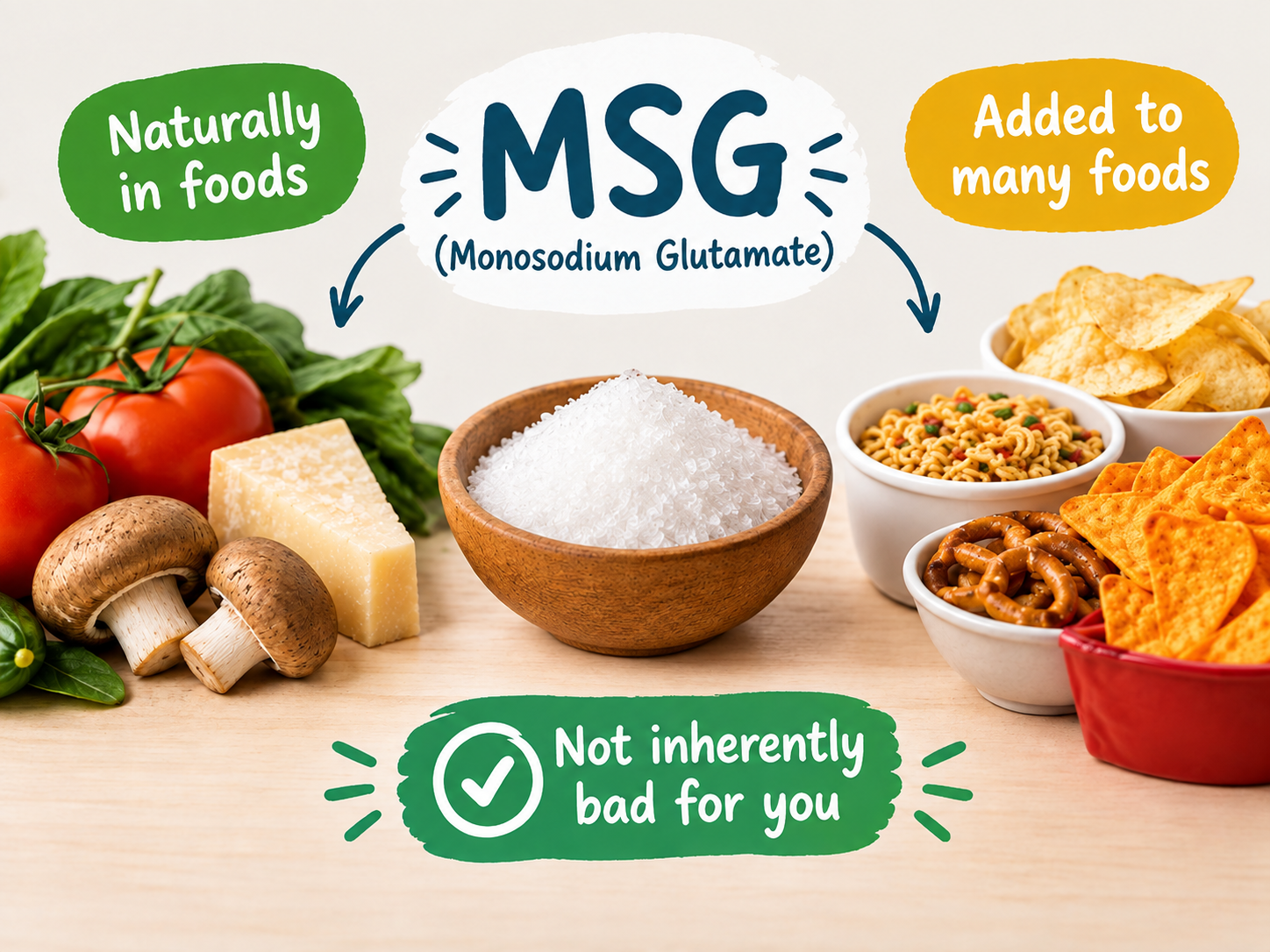
One of the most important things to understand about MSG is that glutamate is naturally present in many foods.
Tomatoes, mushrooms, cheese, and other foods contain glutamate. Your body also produces and uses glutamate, including as an amino acid involved in normal metabolism and neurotransmitter function.
When you consume MSG, your digestive system breaks it down into its component parts, including glutamate and sodium. The glutamate from MSG is chemically the same as glutamate found naturally in food.
In other words, your body doesn't distinguish between glutamate from a tomato and glutamate from a pinch of MSG based on where it came from.
The FDA considers added MSG to be generally recognized as safe (GRAS). Scientific studies have not consistently demonstrated that MSG causes the broad range of symptoms commonly attributed to it.
That doesn't mean every person will feel exactly the same after consuming MSG, or that every possible research question has been answered. But the evidence does not support treating ordinary amounts of MSG in food as inherently dangerous.
Is MSG Bad for You?
Some people report experiencing headaches, flushing, tingling, or other symptoms after consuming MSG. These reports led to what was historically called "Chinese Restaurant Syndrome," now more commonly referred to as MSG symptom complex.
However, controlled studies have generally failed to consistently reproduce these symptoms in people consuming MSG in typical food settings. Some research has found that large doses of MSG consumed without food can cause transient symptoms in certain individuals, but these conditions do not necessarily reflect normal dietary exposure.
Therefore, MSG is not something most people need to fear or avoid simply because it is MSG.
MSG & Sodium
One thing worth remembering is that MSG does contain sodium. However, MSG is not identical to table salt, and it contains less sodium by weight. MSG is approximately 12% sodium, whereas table salt is approximately 39% sodium.
This means MSG can potentially be used to provide savory flavor while reducing the amount of sodium needed from table salt. That doesn't mean adding MSG automatically makes a meal low in sodium, but it can be a useful tool for seasoning.
On the flip side, adding MSG to a meal that already contains a lot of salt can increase its total sodium content. The amount of each seasoning matters, so consider the total sodium in the finished dish rather than focusing on MSG alone.
MSG & Flavor
Adding a small pinch of MSG to your food is a great way to boost its flavor profile. This can be particularly useful for vegetarian and vegan foods, which may not contain the same naturally occurring savory compounds found in meat, fish, or broth.
Try adding a little MSG to grilled vegetables, tofu, soups, stews, or mashed potatoes. It can help bring out a deeper savory flavor without requiring meat or large amounts of additional salt.
MSG isn't a substitute for every component of good cooking, though. Browning, acidity, herbs, spices, and texture all contribute to the overall flavor of a dish. Think of MSG as another tool in your seasoning toolbox.
MSG & Junk Food
Although you may not know exactly what MSG is, I bet you'd recognize the taste it helps create.
MSG can make foods taste more savory and appealing. And when you combine savory flavor with salt, fat, refined carbohydrates, and an enjoyable crunch, you can end up with addictive junk food.
I'm not saying that MSG is inherently addicting. It's just one of the components that may make Doritos or Pringles hyper-palatable, in addition to the salt, fat, refined carbs, and texture.
The appeal of highly palatable snack foods comes from a combination of sensory characteristics, ingredients, reward, and eating behavior. "Once you pop, you can't stop."
But MSG is not unique to junk food. It can be used in nutritious meals, too.
Should you Avoid MSG?
For most people, there is no compelling reason to avoid ordinary amounts of MSG solely because of its name. You don't need to buy instant ramen labeled "No MSG" simply because you believe MSG is inherently harmful.
That said, the presence or absence of MSG does not tell you whether a food is nutritious. For example, if you're choosing instant ramen, you might want to consider the overall nutritional profile:
- High refined starch content
- High sodium content
- Limited vegetables or other nutrient-dense ingredients
- Low fiber content
- Low protein content
MSG can be part of a healthy meal, and a food without MSG can still be highly processed or nutritionally limited. The prescense or absense of MSG itself is not a reliable way to judge the quality of the entire product.
MSG in Home Cooking
I wouldn't tell you to avoid MSG. In fact, I'd encourage you to experiment with it.
Used intentionally in home cooking, MSG can make foods like grilled vegetables, tofu chili, soups, and side dishes taste richer and more savory. It's especially useful when you want to build umami without relying on meat or large amounts of added salt.
Try adding a small pinch to your next tofu chili or mashed potatoes. Start with a little, taste, and adjust as needed. The goal isn't to make every food taste like meat. It's to create a more satisfying and balanced flavor.
Conclusion
MSG is not inherently bad for you. It's a seasoning that provides umami flavor, and the glutamate it contains is chemically the same as glutamate found naturally in many foods.
The concerns surrounding MSG have been exaggerated in many popular discussions, and the scientific evidence does not support treating ordinary MSG consumption as dangerous for most people.
At the same time, MSG isn't a magical ingredient that makes junk food unhealthy, nor is it the primary reason snack foods are addictive. A soda wouldn't be sweet without sweet-tasting ingredients. Chips wouldn't taste the same without their combination of salt, fat, texture, and flavor compounds.
MSG itself is not inherently the problem. The problem is judging an entire food based on one ingredient. Instead of fearing MSG, learn what it does, how to use it, and how the food it's added to fits into your overall diet.
A pinch of MSG in a nutritious meal? No problem. A bag of chips that happens to contain MSG? Judge the chips based on the whole product, not just the seasoning.
MSG is a tool. Use it wisely.
This post may contain affiliate links