
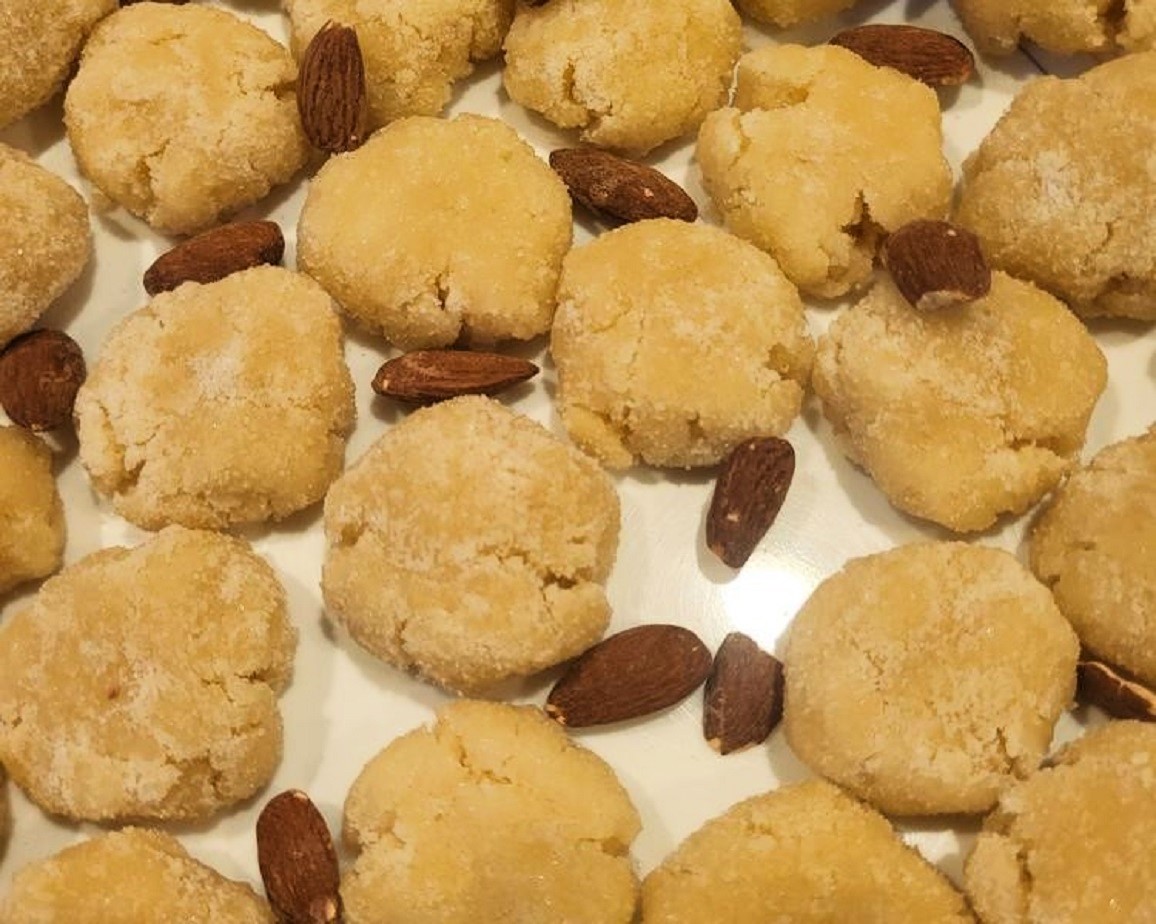
Description
Amaretti cookies are an Italian classic at any holiday, and always my favorite dessert at the table. Traditionally containing almond flour instead of white flour and no butter or oil, amaretti cookies can be made healthy with very little changes. This recipe is identical to the traditional, except with granulated sugar swapped for granulated monk fruit. Or you can make my Amaretti Cookies with Dates instead if you prefer a more naturally sweetened version. Both are gluten free, don't have any butter or oil, and get their healthy fats from almonds. Or check out any of my other cookie recipes! To use up those leftover yolks, whip up a quick Greek Yogurt Hollandaise Sauce.
Time
Prep Time:
10 minutes
Rest Time:
1 hour
Cook Time:
13 minutes
Total Time:
1 hours
23 minutes
Cost
Total Cost:
Cost per Serving:
$0.22
Ingredients
Serving(s)
Cookie Dough
- 2 1/2 cup Almond flour
- 1 cup Granulated monk fruit
- 1/4 tsp Salt
- 3 large Egg whites
- 1 tsp Almond extract
- 1/2 tsp Vanilla extract
Rolling
- 3 tbsp Powdered monk fruit
Instructions
Cook Mode Off: Prevents screen dimming
- In a large bowl, mix together the almond flour, granulated sweetener, and salt
- In a separate bowl (glass or metal), beat the egg whites on high speed until medium to stiff peaks. Fresh egg whites are recommended here, as carton egg whites will not beat up as well. A plastic bowl will also prevent the egg whites from whipping properly
- Add the extracts to the eggs and beat to mix
- Gently fold the egg mixture into the flour mixture with a silicone spatula. Mix gently until just combined. Chill dough in the fridge for an hour
- Preheat the oven to 325F and line 2 cookie sheets with parchment paper. In a small bowl, add the powdered sweetener
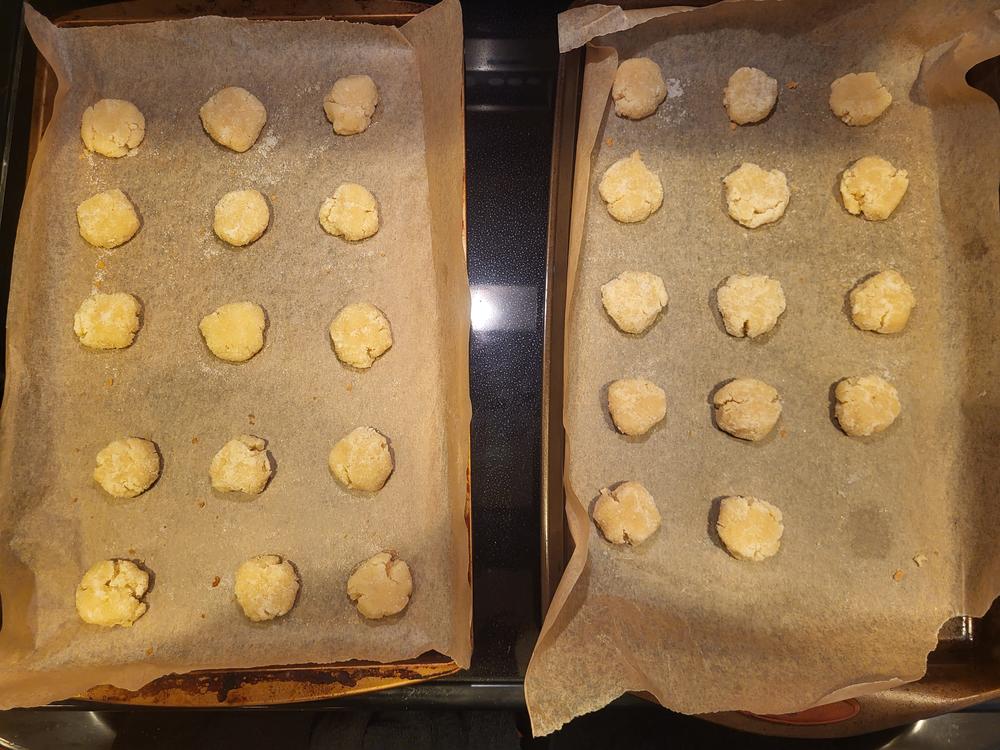
- Scoop your dough into 36 cookie dough balls, about 16 g each. Roll each cookie into a small ball, roll the cookies in the powdered sweetener, transfer to the cookie sheet, and lightly flatten with your fingers
- Bake for 12-13 minutes, rotating the sheets halfway through, or until lighly browned on the sides. Let cool on pan for 5 minutes, or until you can safely lift them up. Transfer to a cooling rack
Notes
- Below is a table comparing if you used either monk fruit or sugar as the sweetener. For the former, that means 1 cup (200 g) granulated monk fruit in the cookies, and rolling the dough in 3 tbsp (24 g) powdered monk fruit. The latter involes using 1 cup (200 g) granulated sugar instead in the cookies, and 3 tbsp (24 g) powdered sugar for the rolling
| Nutrient | Monk Fruit |
White Sugar |
|---|---|---|
| Calories | 48 | 71 |
| Protein | 2.0 g | 2.0 g |
| Fat | 4.1 g | 4.1 g |
| Net Carbs | 0.7 g | 6.9 g |
| Fiber | 0.8 g | 0.8 g |
| Added Sugar | 0.0 g | 6.2 g |
| Sugar Alcohol | 6.2 g | 0.0 g |
Nutrition Facts
------------------------------------------
Total Fat: 4.1g (5%
5 % of Daily Value (78 g)
)
Saturated Fat: 0.3g (2%
2 % of Daily Value (20 g)
)
Polyunsaturated Fat: 1.0g
Monounsaturated Fat: 2.6g
Sodium: 22mg (1%
1 % of Daily Value (2300 mg)
)
Total Carbohydrate: 7.7g (3%
3 % of Daily Value (275 g)
)
Fiber: 0.8g (3%
3 % of Daily Value (28 g)
)
Net Carbs: 0.7g
Total Sugar: 0.4g
Sugar Alcohol: 6.2g
Protein: 2.0g (4%
4 % of Daily Value (50 g)
)
------------------------------------------
------------------------------------------
Vitamin B12: 0.0mcg (0%
0 % of Daily Value (2.4 mcg)
)
Vitamin D: 0.0mcg (0%
0 % of Daily Value (20 mcg)
)
------------------------------------------
Calcium: 19mg (1%
1 % of Daily Value (1300 mg)
)
Iron: 0.26mg (1%
1 % of Daily Value (18 mg)
)
Magnesium: 21mg (5%
5 % of Daily Value (420 mg)
)
Potassium: 56mg (1%
1 % of Daily Value (4700 mg)
)
:
:
------------------------------------------
:
------------------------------------------
2.1
:
0.1
------------------------------------------
:
9.3
------------------------------------------
This post may contain affiliate links