Table of Contents
- Introduction
- What is a Drink?
- Isn't Red Wine Supposed to be Healthy?
- Why Did Alcohol Ever Look Healthy?
- Alcohol-Related Deaths
- Alcohol and Cancer
- Calories & Nutrition
- Should You Drink?
- Conclusion
Introduction
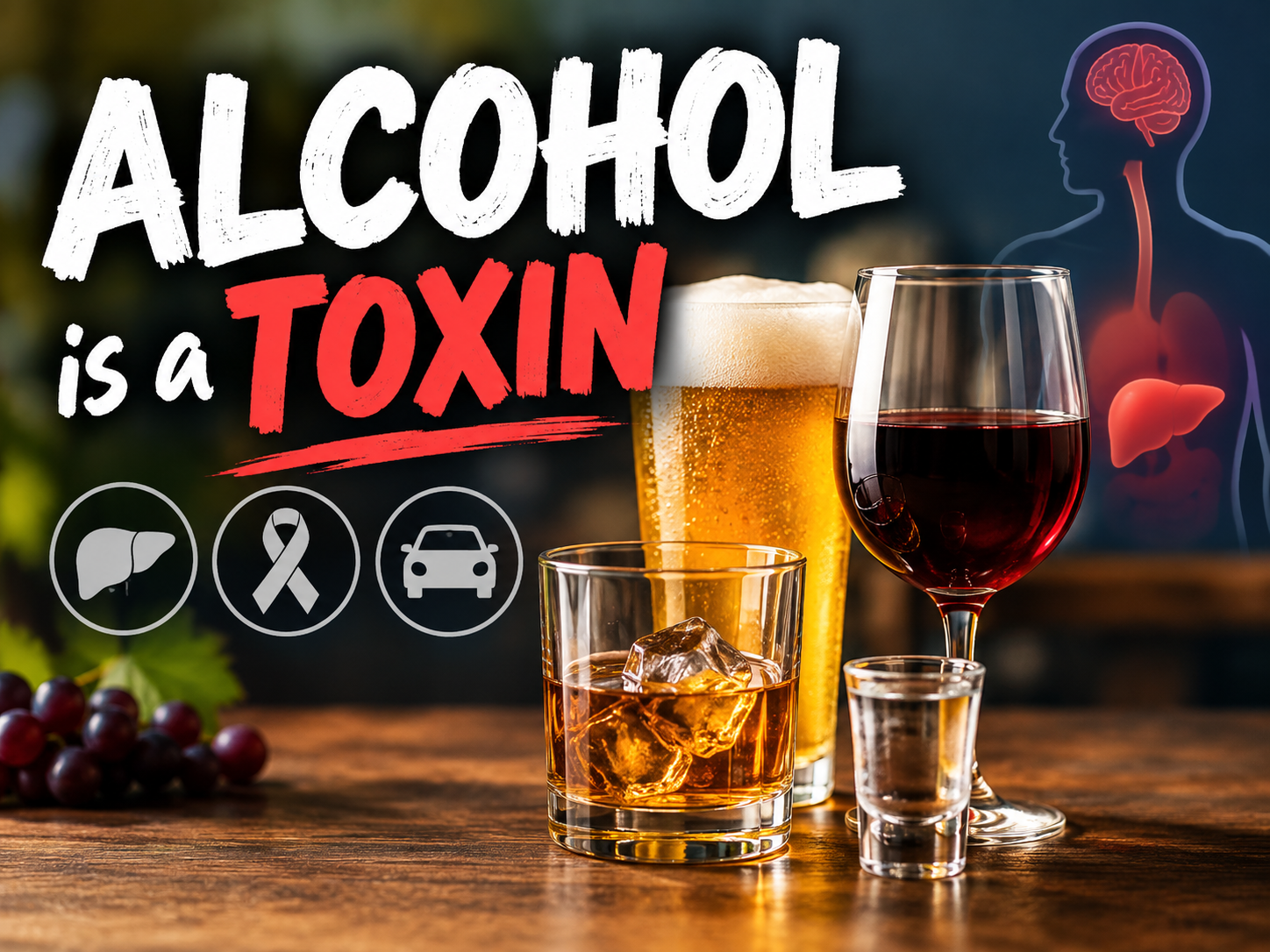
Alcohol is a toxin. There's really no way around that.
The alcohol in beer, wine, and liquor is ethanol, a psychoactive substance that affects practically every part of the body. Your liver has to metabolize it, and the process produces compounds that can damage cells and contribute to inflammation and disease.
Alcohol is also classified as a carcinogen, and the risk of several cancers increases with alcohol consumption.
That doesn't mean that having a drink automatically makes you unhealthy. It means that alcohol isn't a health food, and there isn't a level of consumption that can honestly be described as completely risk-free.
In fact, the relationship is pretty straightforward: less alcohol means less alcohol-related risk.
The U.S. dietary guidelines have historically defined "moderate drinking" as up to 2 drinks in a day for men, and up to 1 drink in a day for women. The CDC also emphasizes that even moderate drinking can carry health risks compared with not drinking.
So if you need a drink every evening after work to "unload" or "relax," I'd take a step back and ask yourself why.
What is a Drink?
You often hear things like "moderate drinking is 2 drinks a day for men or 1 drink a day for women", without stopping to consider, "what is considered 1 drink"? A standard drink is generally classified as something with about 14 g of pure alcohol.
Examples of a standard drink are the following:
- 12 oz (355 ml) beer (5% ABV)
- 5 oz (148 ml) wine (12% ABV)
- 1.5 oz (44 ml) liquor (40% ABV)
A giant IPA, generous wine pour, or strong cocktail can easily contain more than one standard drink.
Note that ABV stands for "Alcohol by Volume". It is a percentage of a beverage's total volume that is made up of alcohol. Sometimes you also hear the word "proof". Proof is simply double the ABV. So if a liquor is 80 proof, then it's 40% ABV.
Isn't Red Wine Supposed to be Healthy?
I bet you're thinking: Wait a minute. Isn't red wine good for you? Haven't there been studies showing that a glass of red wine a night can actually be beneficial?
One of the compounds frequently brought up in discussions about red wine is resveratrol, a polyphenol found in the skins of grapes and several other plants. Resveratrol has antioxidant and other biological effects that have made it interesting to researchers. However, evidence that consuming resveratrol through red wine provides meaningful health benefits in humans is lacking.
But that doesn't mean wine is a good way to get it. You wouldn't eat ketchup primarily because you want lycopene. You'd eat tomatoes.
Likewise, you don't need to drink wine to get compounds found naturally in grapes. You can simply eat grapes and other fruits, vegetables, nuts, and legumes that provide a wide variety of beneficial plant compounds, without the toxic alcohol.
Additionally, the alcohol itself is the thing associated with the health risks. The fact that wine contains potentially beneficial compounds doesn't make the ethanol disappear.
The same principle applies to dark chocolate. Cocoa contains genuinely interesting compounds, but that doesn't automatically make every chocolate product a health food. Unsweetened cocoa powder is very different from a milk chocolate candy bar loaded with added sugar and saturated fat.
Food can contain something beneficial without the entire food becoming beneficial, and red wine is a great example of this.
Why Did Alcohol Ever Look Healthy?
So why did some studies seem to suggest that people who drink small amounts of alcohol, particularly red wine, might live longer?
One possible explanation is healthy-user bias. People who drink wine aren't randomly assigned to drink wine. Their drinking habits are connected with all sorts of other characteristics: income, education, diet, smoking, exercise, social activity, and many other lifestyle factors.
If wine drinkers happen to have healthier lifestyles in other ways, simply comparing them with non-drinkers can make the wine look healthier than it really is.
This is one reason observational studies can be tricky. The researchers can observe that two things happen together without being able to prove that one caused the other. Correlation ≠ Causation.
The CDC notes that earlier studies of moderate drinking often did not adequately account for factors such as exercise, diet, and tobacco use, and that more recent evidence has challenged the idea that moderate drinking provides a net health benefit.
Another possibility worth considering is the social aspect of drinking. You might have a beer with your friends at a restaurant, a glass of wine at dinner with your family, or a drink at a wedding.
But the health benefit in that situation, if there is one, wouldn't necessarily come from the alcohol. It could come from the fact that you're spending time with people you care about.
If your choices are having a drink while spending two hours laughing with your friends, or sitting alone doom-scrolling TikTok, the social interaction is probably the more important part of the equation.
That doesn't mean alcohol is healthy. It means that real life is more complicated than looking at one ingredient in isolation.
And you should absolutely socialize with your friends, family, and anyone else you enjoy spending time with. If a drink happens to come along with that, that's your choice.
Just remember that the social benefits come from the people and the experience, not from the alcohol itself. You can also hang out with the homies without drinking and get the social benefits without the alcohol-related risks.
Alcohol-Related Deaths
Speaking of socialization though, DON'T DRINK AND DRIVE! I really shouldn't have to say that...
Alcohol impairs reaction time, coordination, judgment, and the ability to make safe decisions, making it significantly more dangerous to operate a vehicle after drinking. In the United States, alcohol-impaired driving kills thousands of people every year, including drivers, passengers, pedestrians, and other innocent road users.
(Not so) fun fact: According to the National HIghway Traffic Safety Administration (NHTSA), in 2024, 11,904 people died in alcohol-impaired driving crashes in the United States. That's approximately one death every 44 minutes, or 32 deaths every day.
You don't have to feel drunk for alcohol to affect your driving, and even a relatively small amount can put someone's life at risk. If you're drinking, don't drive. Get a sober driver, use a rideshare, or find another way home.
Alcohol and Cancer
One of the most important health risks associated with alcohol is cancer. Alcohol is classified as a Group 1 carcinogen, meaning there is strong evidence that it can cause cancer in humans.
This applies to all alcoholic beverages, including your precious red wine. Your body breaks alcohol down into acetaldehyde, a toxic compound that can damage DNA and interfere with the processes your cells use to repair that damage.
Alcohol can also contribute to cancer through other mechanisms, including oxidative stress and changes in hormone levels.
The risk isn't limited to people who drink heavily. Even relatively low levels of alcohol consumption can increase the risk of certain cancers, including breast, mouth, throat, esophageal, liver, and colorectal cancer.
In general, the more alcohol you drink, the greater your risk. This is one of the reasons why drinking red wine doesn't get a special exemption from the health risks of alcohol. Whatever potentially beneficial plant compounds wine contains, the ethanol is still there.
For more information see the guidelines by the National Cancer Institute and the CDC.
Calories & Nutrition
There's also a nutritional reason to pay attention to alcohol: alcohol contains calories.
Alcohol provides about 7 calories per gram. For reference, carbs and protein contain 4 calories per gram, while fat contains 9 calories per gram.
But unlike protein, carbohydrates, and fat, alcohol isn't an essential nutrient. Your body doesn't need you to consume it. Well technically you don't need, to consume carbohydrates, but that's a topic for another day (see Carbs are Overrated & Carbs are Underrated).
Since a standard drink contains 14 g of alcohol, a standard drink will have at least 100 calories. A drink can therefore add a meaningful amount of calories without providing any essential nutrients from the alcohol itself.
And that's before you factor in any additional sugar or carbohydrates that are present in the drink, whether they're externally added or naturally present. Beer contains carbohydrates. Wine contains some sugar. Cocktails can contain substantial amounts of added sugar from syrups, juices, soda, and liqueurs.
That's not to say that every alcoholic drink is a nutritional disaster. A plain liquor mixed with a zero-calorie mixer is very different from a giant frozen cocktail. But if you're trying to understand your diet, don't forget to count the alcohol itself.
Should You Drink?
I don't think you need to drink alcohol to live a healthy, enjoyable life. There is nothing wrong with drinking occasionally, and there's certainly nothing wrong with choosing not to drink at all.
Drinking habits vary across generations and populations, and some people are choosing to drink less or not at all. Whatever your reasons, you don't need alcohol to socialize, celebrate, or relax.
On the other hand though, I don't think you need to live your life terrified of alcohol. Having a couple of drinks at a wedding, holiday, birthday, or other special occasion isn't going to determine whether your overall diet is healthy.
Your health isn't determined by one night of eating cake and drinking champagne. It's determined by what you do consistently. There's a big difference between having a few drinks several times a year because you genuinely enjoy the occasion, and needing alcohol every night to get through the day.
The same principle applies to dessert. Having a couple of cookies and a slice of cake at Christmas isn't the same thing as eating dessert every night after dinner.
You can enjoy your life. You can celebrate. You can eat cake. You can have a drink. But I'd keep these things occasional rather than routine.
And if you're going to drink, remember that less is generally safer than more. There is no special health benefit you need to chase by starting to drink, and red wine doesn't get a special exemption from the risks of alcohol. All alcoholic beverages contain ethanol, and drinking alcohol increases the risk of several cancers.
Conclusion
Alcohol isn't a health food. It's not even a food. It's a carcinogenic, toxic substance.
It carries risks ranging from impaired judgment and accidents to liver disease, cardiovascular problems, dependence, and cancer. The risk generally increases as consumption increases, and there is no known completely risk-free level of alcohol consumption.
But that doesn't mean you necessarily have to swear off alcohol forever. Added sugar is likely the main culprit for our obesity epidemic, but your health isn't destroyed by a single cookie. Likewise, a single glass of wine doesn't ruin your overall health.
But you should understand what you're actually consuming. Don't drink red wine because you think it's medicine. Don't drink every night because you think "moderate" means healthy. And don't convince yourself that alcohol is necessary to relax or socialize.
If you enjoy a drink occasionally, enjoy it for what it is: a recreational indulgence.
This post may contain affiliate links