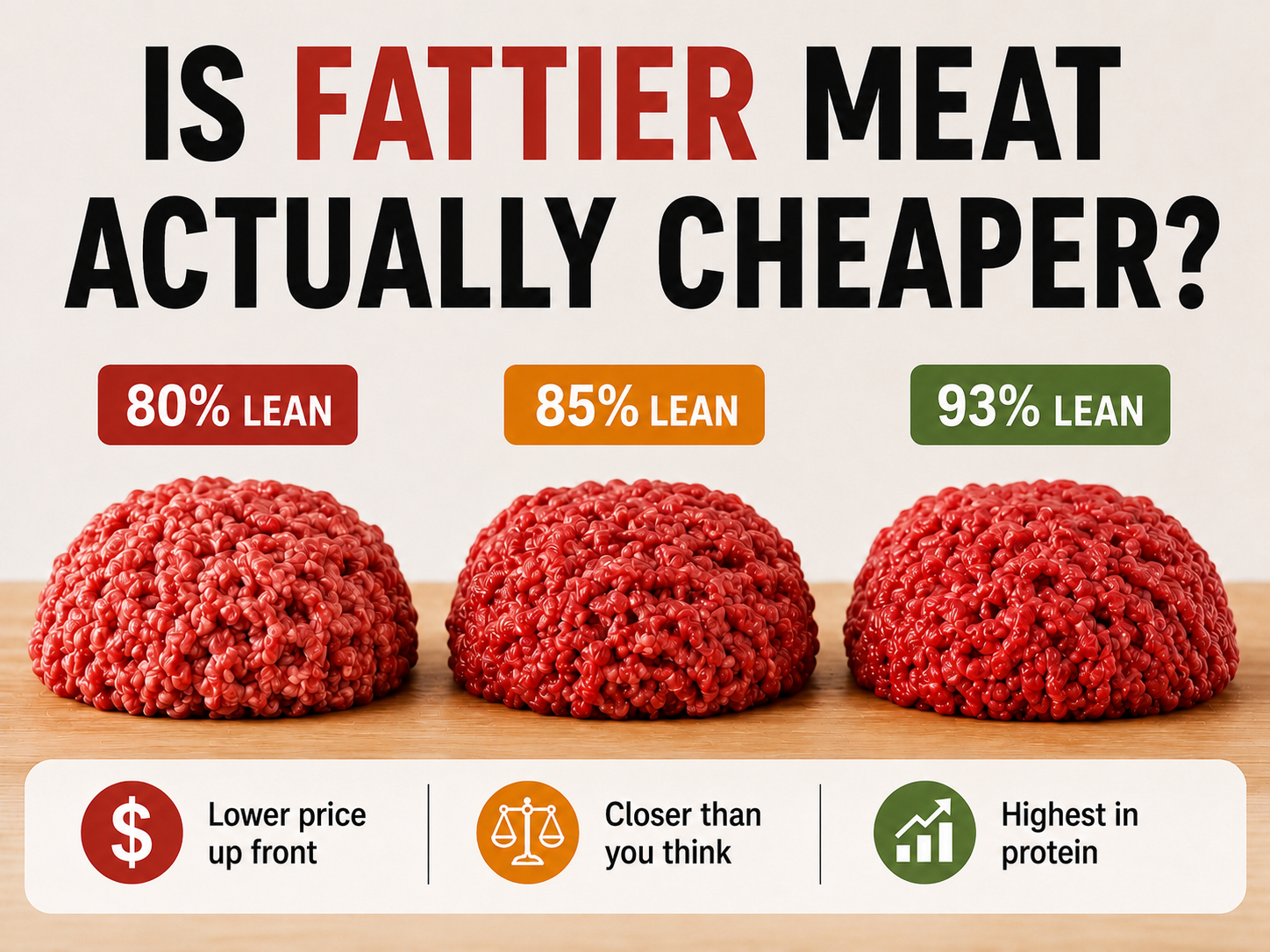
I typically opt for leaner cuts of ground meat, such as 93% lean turkey or beef, as opposed to fattier options like 85% or 80% meat. But many people buy these fattier varieties because they're cheaper. But are they actually cheaper?
At first glance, yes fattier cuts of meat are cheaper. Let's look at beef prices in my grocery store. Per pound, the prices are the following:
With fattier ground meat, you're paying less, but you're also getting less. That's because proportionally more of the weight is made of up fat, so you get comparatively less meat.
Let's assume that 93% lean meat is exactly 93% meat and 7% fat. And let's also make the same respective assumptions for 85% lean and 80% lean beef. If you were to drain away all the fat, what is the net cost of meat per pound?
So while, yes, leaner ground meat is more expensive per pound than fattier meat, the difference is less stark as it may seem when just looking at the gross prices.
Finally, let's compare the cost of the meats by its most important attribute: protein. For many people, the primary reason for eating meat is its protein content. For the cost, you want to maximize the amount of protein while minimizing the cost of non-protein calories.
Although 93% lean beef appears significantly more expensive at first glance, the difference largely disappears when comparing the amount of protein you're actually buying. The 93% lean beef costs about 30.1% and 18.2% more per pound than 80% and 85% beef, respectively.
Per cost of protein, however, fattier meat is hardly cheaper than leaner meat. Comparing 80%, 85%, and 93% ground beef, the costs per gram of protein are a respective 6.4¢, 6.5¢, and 6.9¢.
That means that 93% lean beef is only 7.8% more expensive than 80% beef, and 93% lean beef is only 6.2% more expensive than 85% beef. Since protein is the primary reason many people eat meat, the leaner option is much more competitively priced than it initially appears.
At first glance, yes fattier cuts of meat are cheaper. Let's look at beef prices in my grocery store. Per pound, the prices are the following:
- 80%: $4.99
- 85%: $5.49
- 93%: $6.49
With fattier ground meat, you're paying less, but you're also getting less. That's because proportionally more of the weight is made of up fat, so you get comparatively less meat.
Let's assume that 93% lean meat is exactly 93% meat and 7% fat. And let's also make the same respective assumptions for 85% lean and 80% lean beef. If you were to drain away all the fat, what is the net cost of meat per pound?
- 80%: $4.99 ÷ 0.80 = $6.24
- 85%: $5.49 ÷ 0.85 = $6.46
- 93%: $6.49 ÷ 0.93 = $6.98
So while, yes, leaner ground meat is more expensive per pound than fattier meat, the difference is less stark as it may seem when just looking at the gross prices.
Finally, let's compare the cost of the meats by its most important attribute: protein. For many people, the primary reason for eating meat is its protein content. For the cost, you want to maximize the amount of protein while minimizing the cost of non-protein calories.
| Nutrient | 80% | 85% | 93% |
|---|---|---|---|
| Cost/lb | 4.99 g | 5.49 g | 6.49 g |
| Protein/lb | 78 g | 84 g | 94 g |
| Cost per g Protein |
6.4 ¢ | 6.5 ¢ | 6.9 ¢ |
Although 93% lean beef appears significantly more expensive at first glance, the difference largely disappears when comparing the amount of protein you're actually buying. The 93% lean beef costs about 30.1% and 18.2% more per pound than 80% and 85% beef, respectively.
Per cost of protein, however, fattier meat is hardly cheaper than leaner meat. Comparing 80%, 85%, and 93% ground beef, the costs per gram of protein are a respective 6.4¢, 6.5¢, and 6.9¢.
That means that 93% lean beef is only 7.8% more expensive than 80% beef, and 93% lean beef is only 6.2% more expensive than 85% beef. Since protein is the primary reason many people eat meat, the leaner option is much more competitively priced than it initially appears.
This post may contain affiliate links